
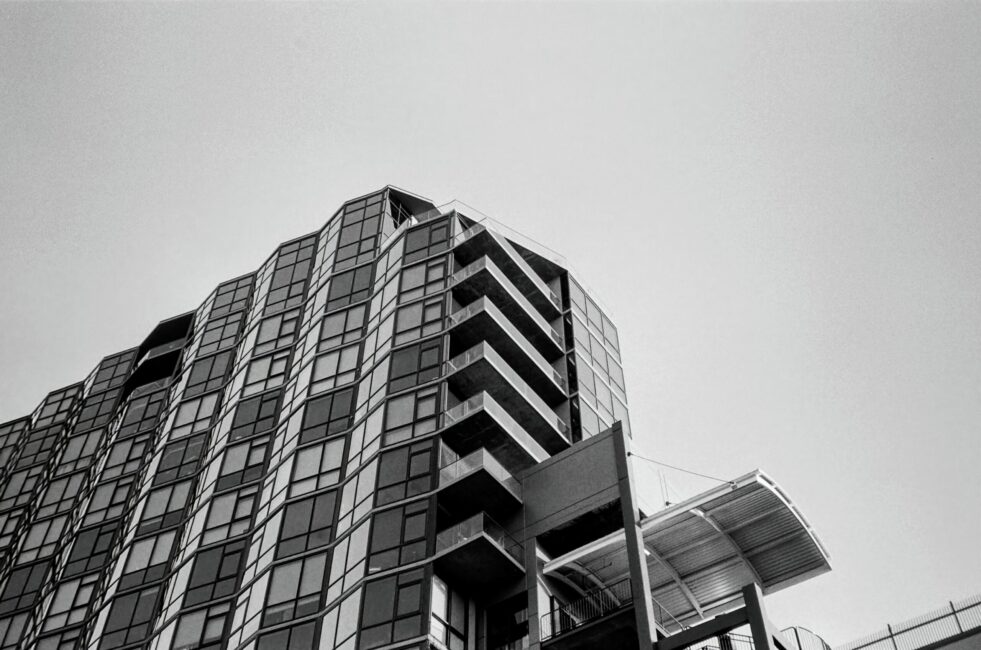
In our world that is currently defined by transparent architecture and constant self-exposure online, perhaps the most important space to protect is the interior one.
The Digital Age of Self-Exposure…
In cities around the world, transparent architecture has become the new skyline. Walls of glass replace stone and steel, and buildings are designed to be looked at as much as to be lived in. Apple’s minimalist design has made the cultural journey from phone to building.
This shift mirrors our lives online, where profiles and algorithmically-curated feeds have replaced the private, interior lives we lead. Philosopher Byung-Chul Han argues that we now live in an age of “voluntary self-exposure,” in which we do not need to be watched—because we are constantly watching ourselves.
This idea struck me after getting back the film I developed from a walk downtown last year. Among the shots I took was an image of a sleek, all-glass high-rise. While the photograph was simply one frame I subconsciously wanted to capture on the strip, it seemed to embody a larger truth about digital culture: every reflective pane was like a fragment of the self. The building wasn’t just a piece of my local urban design; it was a physical metaphor for the online visibility that has become our default mode of existing.
Han warns that this constant exposure carries hidden costs. In The Burnout Society, he writes, “Neuronal violence leading to psychic infarctions is a terror of immanence.” In other words, the pressure to be constantly present, active, and visible can wear us down at the deepest level.—I certainly feel this with my daily job (which I might go into more detail later) and hence the reason why I am trying to express myself via this art form!—
Transparent design—whether in architecture or in our online lives—creates a world with no shelter, no true interior. We become performers without intermission. We become self-salesman of even our personal image (read ‘Instagram’)
This transparency links directly to what Han calls “the massification of positivity.” Just as glass architecture functionally eliminates shadows, our culture often eliminates the negative spaces in life: the pauses, silences, and private moments that allow us to recharge. This reminds me of Cal Newport’s idea of “The Deep Life”, wherein we intentionally use the analog means of doing something, or take the longer route, or enjoy a walk in the middle of a work day— in order to preserve that sacred inner space where reflection allows us to process our daily lives.
Film photography offers this opportunity to me in spite of this era of hyper-visibility. Shooting on film requires patience. There is no instant upload, no immediate feedback loop. Images wait in the dark until they are developed, giving time for thought and distance. My photograph of the glass building existed for nearly a year before I saw it printed, and in that time it shifted from documentation to reflection.
The lesson is simple but radical in a digital age: reclaiming opacity matters. Not all aspects of our lives need to be shone in the spotlight and up for public consumption (Maybe only select ones like on these essays).
Some relationships, thoughts, and experiences should remain private—not because they are shameful, but because privacy is what gives them depth. Even glass, in the right light, reflects instead of reveals.
In our world that is currently defined by transparent architecture and constant self-exposure and self-optimization online, perhaps the most important space to protect is the interior one—the place that cannot be photographed, posted, or performed. My photograph reminded me of this: the value of holding something back. In resisting the demand for endless views, likes, and clicks, we protect our humanity from becoming just another surface in a world of glass.
