
Try What I Call, “The Scenic Route Philosophy“…
In an era built on acceleration, deliberately slowing down might be the most subversive choice you can make.
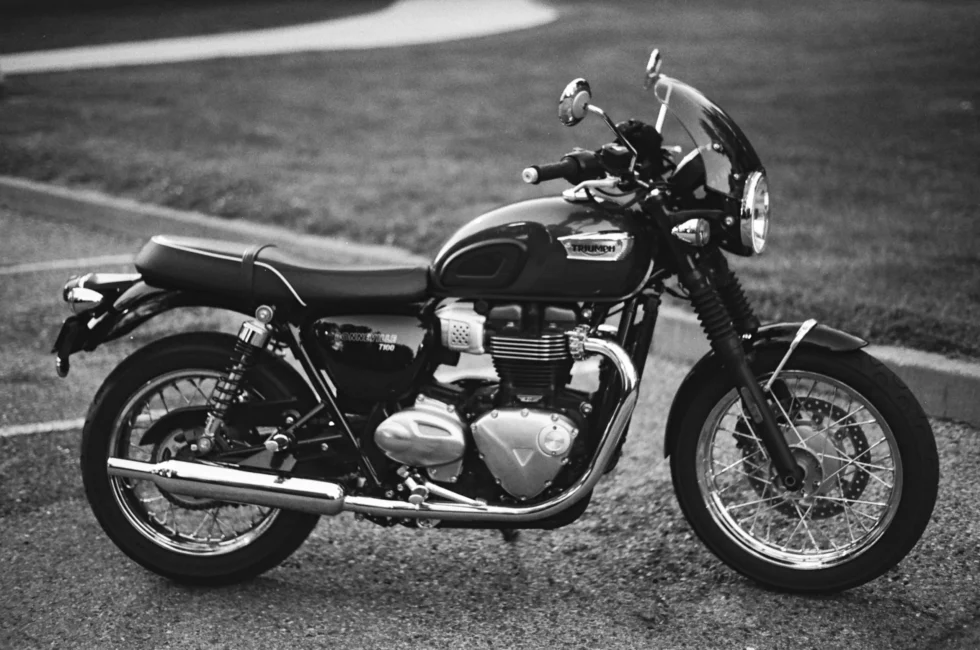
A few months back, I stood behind my Minolta SRT 101, and framed up (what I think) was a great shot of a parked Triumph Bonneville. It was the kind of machine that doesn’t go for speed records. Instead, it invites you to notice the curvature of the road, the gusts of air, and the passing scenery. Later, when I saw the final developed image, it hit me that the same principle applies beyond just travel—in an era built on acceleration, deliberately slowing down might be the most subversive choice you can make.
The Problem: A Culture of Relentless Speed
Modern life rewards optimization, branding, and most of all velocity. Faster commutes, faster communication, faster gratification (maybe there is a level beyond instant gratification, like premonitory gratification?)…
Byung-Chul Han, in “Vita Contemplativa”, warns that this constant acceleration erodes the contemplative life. We move quickly, but our thoughts become shallow. Without stillness, there is no depth—only a constant rush of input that leaves us overstimulated yet undernourished. A constant skipping and skimming of the surface like a thrown stone across a lake—yet we never delve into the depths of the nourishing water below.
The Scenic Route as Resistance
The scenic route—whether on a winding road, a quiet walk, or in the way we structure our days—is a way of setting boundaries with the tech-obsessed society of today. It is a refusal to let efficiency and optimization dictate the quality of LIVED experience.
Cal Newport’s Digital Minimalism and Deep Work echo this idea in regards to attention: to reclaim focus, you must choose intentional slowness over the dopamine rush of instant digital dopamine. When you slow down, something shifts in your being. The mind starts to wander productively. You begin to notice patterns in the landscape, shifts in light, subtle changes in sound. Han would call this the return of contemplation—the ability to stay within a moment without always grasping at the next. Newport might frame it as depth regained—a state where your attention is no longer fractured by the demands of the algorithm. Rick Rubin would point out that this intentional slowness, this awareness, is where true art and creative pursuit are born into the world.
The Bonneville in my 35mm (Ilford HP5+) shot has turned into yet another reminder to me—that time is not just a metric to compress but a medium to inhabit. You could reach your destination faster on another machine, but what would you lose in that process?
Choosing the slower mode, the deeper mode, the mode of solitude is about preservation.
It’s about preserving our capacity for focus in a distracted world. Preserving spaces—mentally and physically—where depth can survive and, in turn, allow your daily life to thrive once more and flourish with reflection and creativity.
