
These human-to-human exchanges are not content to be consumed; they are human transactions that accrue meaning.
Slowing Down:
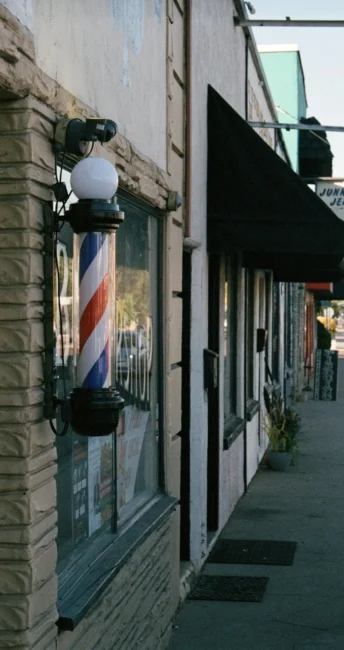
I shot this barber pole in late afternoon about 6 months ago, it’s a storefront that remembers more conversations than the sidewalk does. The picture is a small thing—grain, light, a vertical slice of my downtown—but it holds a proposition: we should slow down. Not as something nostalgic, but as a deliberate, necessary balance to a life designed around immediacy and instant gratification.
A haircut in a barbershop use to be a major life ritual in miniature. You sit, hands folded, and submit to a deliberate choreography: the clipper hums, the cloth is draped over the neck, the brief aside about weather, kids, or summer construction. Time is a purposeful tool here. The barber shapes hair with the same skill and tact they shape conversation. It’s not passive consumption of a service; it is shared attention—shared culture. This shared attention—grounded, and analog in nature, delivers something the screen cannot emulate: presence.
Lessons for Mindful Tech Use:
Film photography teaches the same lesson. You point a camera, you commit to a roll, you wait. The reward arrives through slowness: a developed strip of frames, a single good exposure out of the entire roll, the satisfaction that that patience produces.
It asks for care. It resists instant judgment.
There is another layer—relationship. Barbers keep community members’ small personal histories in their back pockets. They remember names and spouses and the small victories of previous weeks.
These human-to-human exchanges are not content to be consumed; they are human transactions that accrue meaning.
In contrast, algorithmic content trains reflexes. We refresh feeds to feel less alone, open two, three, four tabs to try and somehow feel more informed, and trade depth for the shallow illusion of productivity. The cost is subtle and constant: fractured and disjointed attention, shallow memory, and conversations that skim the surface rather than settle you deep in your soul. The barbershop—and the darkroom—offer an alternative: deliberate practice for re-learning how to attend to life.
PRACTICES:
How do we translate those practices into daily life? Start small. Schedule actual, phone-free times with friends where you simply sit and listen. Buy a print magazine or a secondhand vinyl record and spend an afternoon with it, soaking-in the meaning and intention that is imbued into the medium.
Practical micro-habits help: put your phone in airplane mode during meals—or use Cal Newport’s “Phone Foyer Method”, ask open-ended questions, truly LISTEN to those you talk to as opposed to thinking of the next thing to say.
There’s also restraint: we don’t need to make every moment analog, but we do need anchors—places and rituals that are slow by design. A monthly letter to a friend across the country becomes a checkpoint. A record player, or a weekly newspaper become a practice of slow-intent. These anchors reshape our relationship to technology: making them tools for our USE rather than algorithmic tyrants.
The point of slowing down is simple: to live with more depth and, occasionally, to let silence do the work.
