
We can’t fully escape the mechanism, but we can develop a critical consciousness about our role within it.
At this very moment of typing these words, I am complicit in a performance. I produce this mostly for myself as an archive of my search for meaning in our current age, but the irony—and the crux—is that I was raised in a society where this technology was becoming integrated into our everyday experience. So even creation like this carries the ulterior motive of wanting eyes to see it. To be the spectacle.
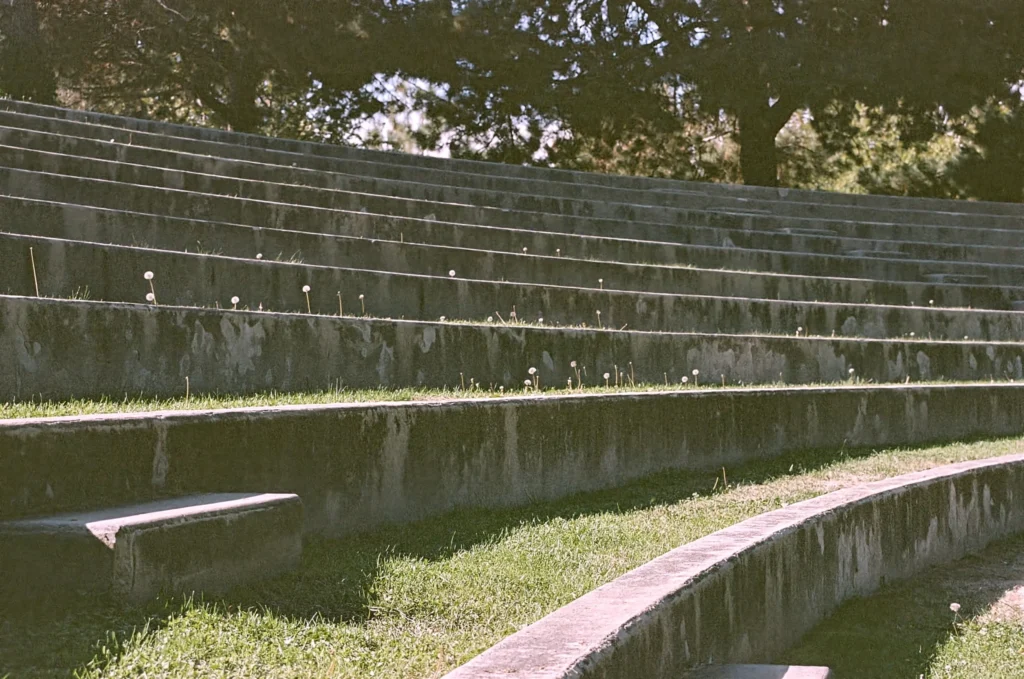
This amphitheater I photographed on 35mm film above, sits abandoned, its concrete steps slowly surrendering to grass and daisies. What was once designed for collective gathering—for shared experience, for the ritual of witnessing—now hosts only the quiet performance of decay. Standing before these empty seats, camera in hand, I’m confronted by a peculiar irony: in our age of omnipresent digital audiences, we’ve somehow lost the art of genuine spectatorship.
Guy Debord’s Society of the Spectacle promised us a world where life became indistinguishable from its representation. He envisioned passive masses consuming carefully curated images, but he couldn’t have predicted how completely we’d internalize this dynamic. Today, we don’t just watch the spectacle—we are it, performing constantly for invisible crowds through screens we carry everywhere.
This overgrown theater feels like an archaeological remnant of a different kind of performance culture. These seats once held bodies that gathered intentionally, who chose to be present for something specific. There was a clear distinction between performer and audience, between the staged and the authentic. The weeds growing between the concrete slabs suggest nature’s own critique of our constructed environments, a slow reclamation that happens when we stop maintaining our stages.
Byung-Chul Han writes about how we’ve become entrepreneurs of our own souls, constantly optimizing and performing our identities. The exhaustion so many feel isn’t from overwork alone—it’s from the relentless labor of being always “on,” always curating our existence for consumption. Every moment becomes potential content, every experience filtered through the question: how will this look to others?
Here, in this forgotten amphitheater though, something different emerges. The mushrooms pushing through cracks in the seating don’t perform for anyone. The grass grows without consideration for its appeal to others. There’s something deeply subversive about this unwitnessed flourishing, this beauty that exists purely for itself.
Perhaps this is what resistance looks like in the age of the spectacle—not grand gestures or organized movements, but small acts of refusing to perform. The decision to let something grow wild. The choice to experience a moment without documenting it. The radical act of being present without an audience.
As I photograph these empty seats, I’m aware of my own participation in the very system I’m contemplating. Even this abandoned theater becomes content, becomes spectacle through my lens. But maybe that’s precisely the point—We can’t fully escape the mechanism, but we can develop a critical consciousness about our role within it.
The amphitheater’s emptiness isn’t a failure; it’s a meditation. In a world where every surface has become a stage and every person a performer, these quiet seats remind us that some of our most meaningful experiences happen in the spaces between performances, in the moments when we allow ourselves to simply be present without an audience.
The weeds will continue growing whether we document them or not. There’s something profoundly liberating in that indifference.
