
This isn’t a profession of love for organized religion. It’s a testament to the changing landscape of our society.
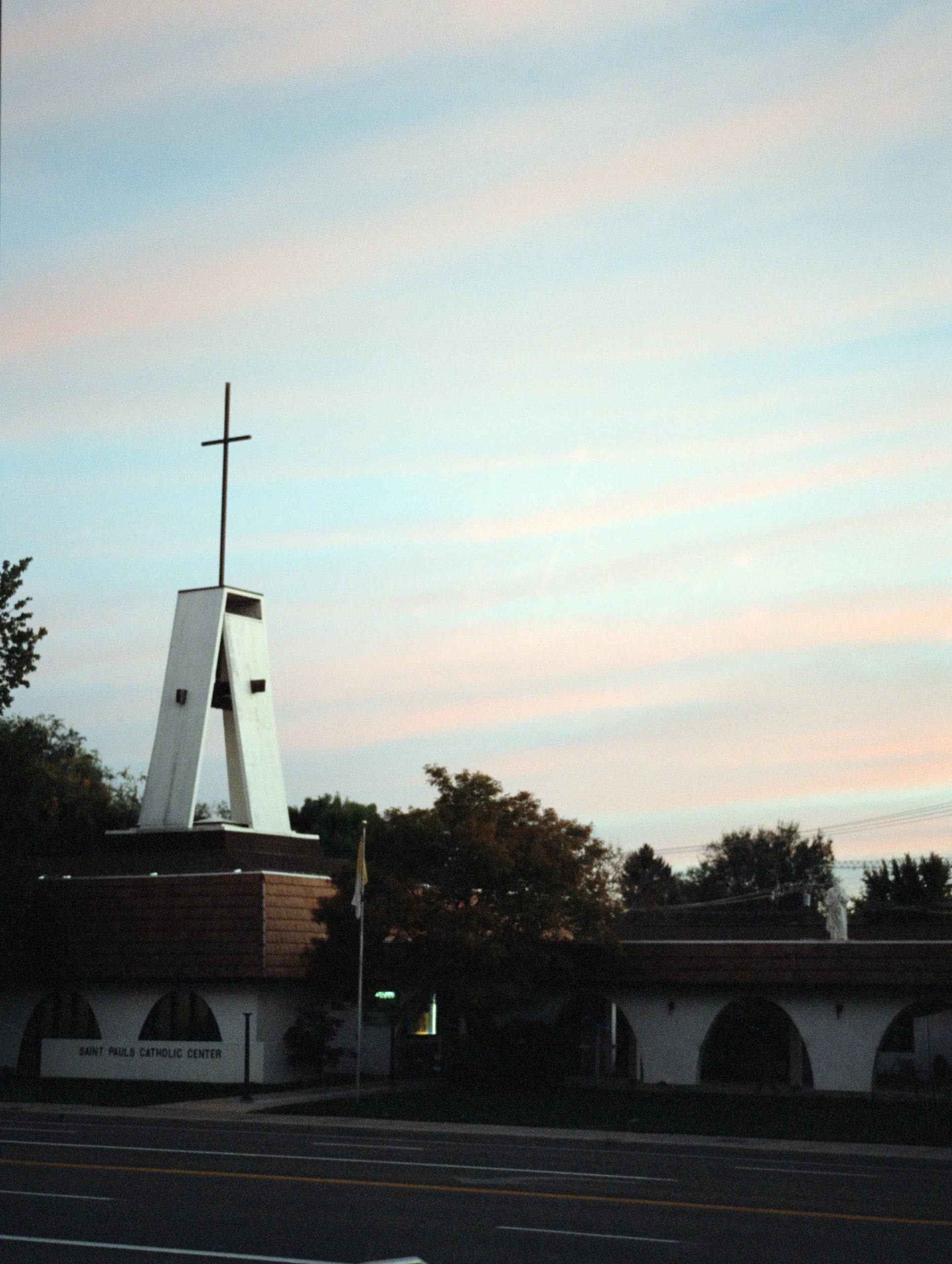
There’s something unsettling about this image of a church at dusk—not because of what’s there, but because of what surrounds it. The stark white tower stands at attention in front of a cotton-candy sky, its cross still reaching upward in defiant assertion of transcendence. Yet the frame tells a different story entirely.
Look closer toward the edges. Power lines slice through the frame like economic arteries, carrying not lifeblood to the body but literal power to America’s capitalist infrastructure—the kind of power that lights up strip malls and charges phones and keeps the machinery of commerce humming.
This isn’t a profession of love for organized religion, by any means. It’s a testament to the changing landscape of our society.
The building itself seems almost apologetic, nestled between trees and dwarfed by the infrastructure of daily life. Where once church spires dominated skylines as symbols of communal aspiration toward some “greater good”, now they compete for attention with billboards, cell towers, and the architectural grammar of convenience stores.
It is simply an undeniable fact wherein society has shifted dramatically in its trajectory; we worship not at the altar of a “higher power” (whatever that may be), but instead at the altar of capital and materialism.
We’ve witnessed a quiet revolution in meaning-making. The moral frameworks that once flowed from pulpits and confessionals (whether outdated modes of thought or socially acceptable forms of moral reasoning) have been circumnavigated by the sacred pursuit of more followers, more square footage, more zeros in the bank account.
The irony captured here is profound. The faithful park their status symbols outside before entering to hear about spiritual or moral poverty, then drive home past strip malls and fast-food temples that offer their own forms of salvation: the ephemeral lust of acquisition, the brief orgasmic high of 50% off junk, the dopamine hit of instant gratification.
We’ve created a new cosmology where value is measured not by moral action or character development, but by credit scores and LinkedIn connections.
Perhaps this is what the end of one age looks like: not dramatic destruction, but quiet absorption. The sacred hasn’t disappeared. It’s just been rebranded, monetized, and made available for commodification— just like everything else, morality is engulfed amongst “what’s for sale”.
